

Farm Health
As your soil gets richer – so do you!
The strength of a farm is determined by the health of the soil and therefore the health of the plants grown and the animals that eat the plants. The soil needs to contain a diverse range of flora and fauna as well as sufficient water and minerals.
Table of Contents
Plant Health
For simplicity sake I have divided plant health into 4 layers as defined by Advancing Eco Agriculture.
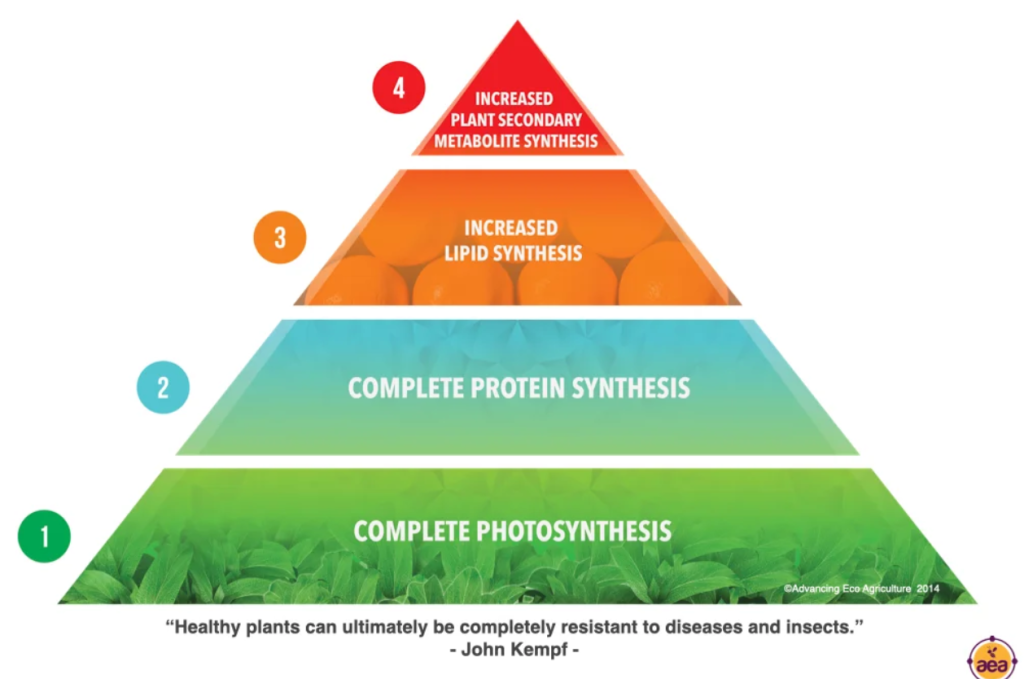
Healthy plants are immune to insect damage and many diseases
Level 1 – Complete Photosynthesis
Plants require adequate levels of magnesium, iron, manganese, nitrogen and phosphorous to reach this stage of health. *Phosphorous is not directly involved in photosynthesis but is needed for photosynthate metabolism with increased sugar production.
Plants develop resistance to soil-borne fungal pathogens such as verticillium, fusarium. rhizoctonia, pythium, phytopthora and others.
The volume of photosynthesis increases anywhere from 150% to 600% and the carbohydrate profile changes to be composed of a high proportion of complex carbohydrates with low levels of non-reducing sugars in the plant sap.
Level 2 – Complete Protein Synthesis
Plants require adequate levels of magnesium. sulphur, molybdenum and boron * to reach this stage of health. *Boron is not directly involved in protein synthesis but contributes additional pest resistance.
Plants become resistant to insects with simple digestive systems, especially larval and sucking insects such as tomato horn worms, cabbage loopers, corn borers, corn ear worms, aphids, leafhoppers, white flies and thrips.
The plant begins converting all of the soluble nitrogen compounds to amino acids and complete proteins so that 100% of the nitrogenin the plant is converted to a complete proteinin every 24 hour cycle. The result is that there are no nitrates and no ammonium remaining in the plant sap in every 24 hour photo period.
Level 3 – Increased Lipid Synthesis
Plants require a very aggressive plant microbiome in the rhizosphere to begin absorbing the majority of their nutrition in the form of microbial metabolites to reach this stage of health.
Plants develop increased resistance to all of the airborne fungal and bacterial pathogens such as downy mildew, powdery mildew, late blight, fire blight, rust, bacterial speck, and bacterial spot which land on the leaf surface and release peptolytic enzymes because the leaves and oils on the leaf surface serve as a shield to prevent the pathogenic enzymes from working.
Plants begin absorbing the majority of their nutrition in the form of microbial metabolites which are extremely energy efficient and they begin storing surplus energy in the form of lipids.
Level 4 – Increased Plant Secondary Metabolite Synthesis
Plants require the correct microbes in the plant microbiome to trigger the immune response to reach this stage of health.
Plants develop increased resistance to the entire beetle family including Japanese beetles, corn rootworm beetles, squash bugs, Colarado potato beetles, cucumber beetles and marmorates stink bugs, nematodes such as root rot nematodes and viruses.
The plant’s immune pathways (SAR and ISR) are triggered by microbes in the plant’s microbiome, both in the rhizosphere and the phyllosphere or by other immune triggers resulting in increased concentrations of immune compounds and plant secondary metabolites.
Companion planting & guilds
The theory of companion planting revolves around chemical and physical compatibility.
It is a complicated system of relationships between plants, fungi, insects and animals. There are as many antagonists as there are companions.
The reason that companion planting is regarded skeptically by many is that the effects are regional.
Take the tomato / basil story. Many nematodes attack tomato roots. The basil traps and feeds on a nematode that ruins tomato roots. The difficulty is that that type of nematode is not found everywhere and basil has a specific taste in nematodes. This only seems to work in southern England and France, so the companion status is unavailable elsewhere. No doubt there are other nematode feeders that will attack our local varieties. Once identified, they are your tomato companions.
The main considerations here are:
- root space competition
- shading and light levels
- root and sap exudates
- pest protection
- mycelium symbiosis
Root space competition
Plants hold their roots at different levels. Some are shallow and others deep. If the roots are competing for water and nutrients, we have a situation where neither species will thrive.
If however the roots are at different levels, we have a symbiosis (helping each other). Consider this, the deep rooted plant extracts nutrients that have leached down to the subsoil, feeds its leaves which then drop in their season. These leaves will release deep nutrients when they decompose that are now available in the topsoil to the shallow rooted plant – win win!
Shading and light levels
There is a famous guild called the three sisters that originates in North America. It is a simple guild of Corn, Squash and Peas. It works by sharing environmental advantages. The large leaves of the squash provide shade and shelter which maintains an even soil temperature and reduces moisture loss. The peas are legumes so provide nitrogen and shade the roots. The corn provides a trellis for the peas and acts as a windbreak.
The corn is shallow rooted, the peas are deep rooted and the squash are middle feeders. Each of the crops can be harvested at different times allowing each to boost their yield in turn.
Pest protection
Root, leaf and sap exudates
Allelopathy is the chemical inhibition of one plant (or other organism) by another by releasing substances that act as germination inhibitors, growth inhibitors or outright poisons. Strong examples of this are Eucalyptus, Black Walnut and Tomatoes.
Soil Health
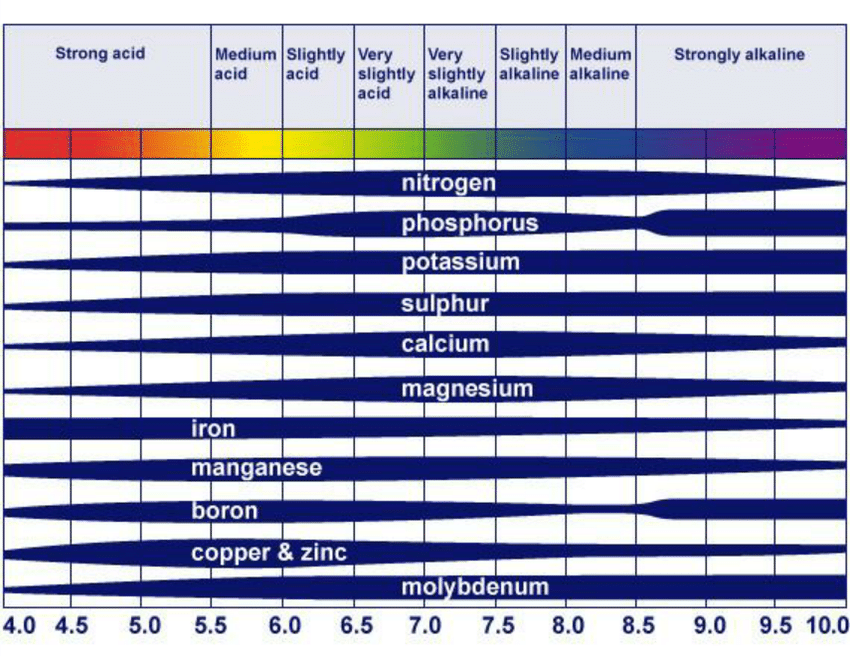
Most soils have sufficient major, minor and trace minerals – the trick is to have them bio-available.
Bio-availability is controlled partly by the pH. Most commercial fertilisers are bio-available only for a short time – funny that. You end up with a massive amount of the “nutrient” in the soil that is not available for the plants – so more is recommended – soil tests only show the available component. These minerals can reach toxic levels yet still be unavailable to the plants.
Many minerals can be processed into usable form by the soil life – especially the mycorrhizal fungi. Go easy on the chemical fertilisers and the herbicides / fungicides unless you want to render your soil useless.
No till
Green mulch
Fungi
Fungi are the oldest and most numerous lifeforms found on the planet. They get a bad rap because many are parasitic. As a group we could not exist without them.
A “mycorrhiza” is a symbiotic association between a fungus and a plant. The “roots” or mycelia of the fungus mine minerals and water from the soil and pass it to plant roots – sometimes over great distance.
Fungi come in many varieties and types – the most common are mycelial and saprophytic.
Mycelial Fungi
Mycelial fungi are comprised of a mass of hyphae or fine roots. They are mostly in a symbiotic relationship with the neighbouring plants.
Saprophytic Fungi
Saprophytic fungi are best described as a group of fungi involved in the processing of decayed (dead or waste) organic matter.
Mycelium symbiosis
Mycelial fungi usually form symbiotic relationships with the plants in their neighbourhood. There is an underground trade economy happening. The fungi provide an underground internet to pass information and channels to trade water, minerals and other substances to the plant in return for starches. It is significant and runs on a bidding system. Soil life is quite complex and intelligent.
Fungi: I have some water, phosphate, chromium and zinc.
Plant: I will take a block of zinc and some water. Here is your starch and sugar.
Fungi 2: Deal
This sounds a little strange, but has been well proven by research over the years. The mycelial tips actually enter the roots of the plants and pass between the cells of the root in order to deliver their goods and chemical intelligence directly to the plant. This was originally mistaken for the fungi parasitising the plants – not at all true. It is a higher form of symbiosis.
In 1998 a fungus Armillaria ostoyae was discovered that covered 2,384 acres (965 hectares). This one however is a parasite. The interesting thing is that it is one connected organism – not a forest of clones.
Author’s Note
Nature is co-operative not competitive.
The “Survival of the Fittest” view of Darwin is a little narrow. Predators and parasites do attack the weak and unhealthy and so maintain the physical and genetic health of the community.
The hyena of the Serengeti is called “The Doctor” by the local tribesmen.
Nature’s interactions are co-operative and supportive. The ecosystem is really one organism with differing moving parts. Our white blood cells are predators and perform the same function for us.
As the the microcosm, so the macrocosm.
Points to Take Away
The ecosystem is best viewed as a single organism with all parts dependent upon every other part. If we selectively damage one part, we damage the effectiveness and efficiency of the whole – and we are part of that organism.
We are here to guide and guard – to make the planet the best we can make it for the benefit of all. Thus we profit.

Prior to devoting my time to Properly Organic and Designer Acres, I served as a contracted super tech in the bleeding edge of satellite imagery, business management and accounting software, then telecommunication software bringing SMS and Mobile Application Protocol into Australia. I then decided to return to the land. I quickly discovered that apart the shape of the bales and the colour of the tractors little had changed.
How useful was this post?
Click on a star to rate it!
Average rating 0 / 5. Vote count: 0
No votes so far! Be the first to rate this post.