The Shape of the Year
…
Every year has a different yet similar “shape”. The shape can be defined as the timing associated with the:
- seasons
- market demand
- economic conditions
- labour shortages
- black swan events
- predicted events
- fake events
All conspire to make each year different with a different set of challenges. We can manage at a broader level from the “average shape” but need to modify the timing and details to meet the current conditions.
Table of Contents
Seasons
Agriculture is dependent and managed by the seasons. The climate changes between the years due to the sunspot cycles, and Milankovitch cycles.
Milankovitch cycles
These are long term cycles.
Eccentricity
The shape of the Earth orbit around the sun is measured by its Eccentricity. The orbit is not a proper circle, rather a varying ellipse.
As our orbit is not circular, we are a different distance from the sun at different tomes of the year. Aphelion is the point of the Earth’s orbit that is farthest away from the Sun. Perihelion is the point of the Earth’s orbit that is nearest to the Sun.
This is controlled by the position of the larger planets (Neptune. Jupiter and Uranus). As you can imagine their gravitational effect is determined by their alignment. Sometimes our orbit is almost circular when their positions are equally spaced around the Sun.
When the planets align, however the orbit becomes quite elliptical due to the greater gravitational pull on our planet. This has a major bearing upon the Earth-Sun distance. The further from the Sun we are the less light and energy we receive. Conversely, when we are nearer the Sun we receive more light and energy.
Our climate is CONTROLLED by the Sun – it affects us by its light, radiation, gravity, magnetic field and our Earth-Sun electrical connection as well as impacting our reducing magnetic field.
Currently, Earth’s eccentricity is near its least elliptic (most circular) and is very slowly decreasing, in a cycle that spans about 100,000 years.
Obliquity
The Earth is tilted which is why we have seasons. This determines how much light and radiation are received at the surface of the planetary hemisphere.
This means that one hemisphere is closer to the Sun than to its partner. The converse is true when we move to the other side of the elliptical orbit.
To add to this effect, historically our tilt varies between 22.1 and 24.5 degrees. It is currently 23.4 degrees and this angle is very slowly decreasing in a cycle that spans about 41,000 years.. The tilt affects the “strength” of the seasons. When at minimum, our seasons are much milder and more even.
Axial precession
The earth also wobbles like a cheap top. The effect is to exaggerate the severity of the seasons. Currently perihelion occurs during winter in the Northern Hemisphere and in summer in the Southern Hemisphere.
This makes the Northern Hemisphere winters milder and the Southern Hemisphere summers warmer. At the other end of the cycle the situation is reversed.
The trend in the direction of this wobble relative to the fixed positions of stars is known as axial precession. The cycle of axial precession spans about 25,771.5 years.
Apsidal precession
The Earth’s entire orbital ellipse also wobbles irregularly relative to the elliptical plane, primarily due to its interactions with the giant planets. The cycle of apsidal precession spans about 112,000 years.
El Nina and La Nino
El Niño means Little Boy, or Christ Child and La Niña means Little Girl in Spanish. El Niño and La Niña represent opposite extremes in the Southern Oscillation of the Pacific Ocean.
These are rooted in the sunspot cycle and affect ocean temperature and therefore rainfall and temperature in Australia and South America.
This effect has both climate and market aspects. When one affects Australia, the other affects South America. This provides differing growing conditions.

Market demand
Markets vary over the year and between the years.
Retailers traditionally purchase from the supplier of lowest cost – the majority are not concerned with quality, only shelf life and price.
The on-farm price for products are quite variable and are affected by the seasons worldwide.
The world is shrinking rapidly so a good season overseas results in a glut and lower prices. This is used in the retailer’s country to supply and so level out the higher demand prices in the country under-producing.
Most primary producers therefore are forced into the position of price takers rather than price makers.
On top of this mischief are the outright lies of the large retailers. Recently there have been false shortages caused by a storm in the banana growing areas of QLD. The storm did damage the crop in the foothills of the Atherton tablelands but that is only one small area compared to the production of bananas countrywide,
Economic conditions

The unfortunate thing about the economy is that it is totally manipulated.
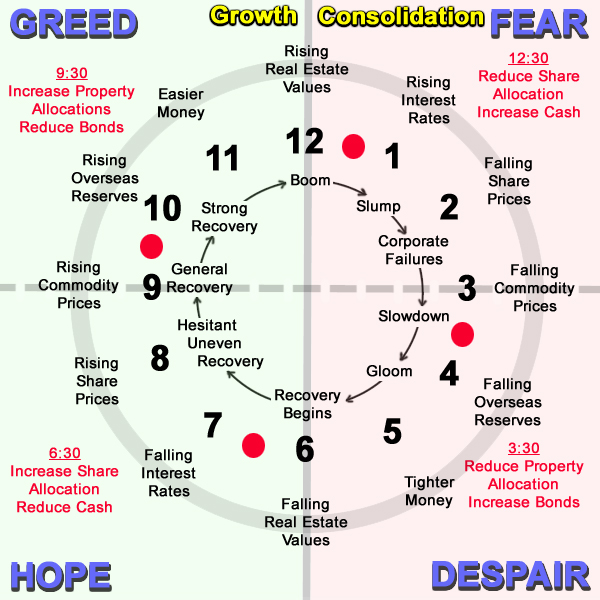
Most people do not look past 1 year – if that. Often their horizon is the next paycheck. The economic cycles catch them unaware. Most cycles are 7-9 years long. These hits are totally created and managed.
Every now and then we cop a recession or in this case a depression which will have a life of its own and take 7-10 years to recover.
This is a pity, as any cycle is a great opportunity to buy low and sell high.
Black swan events
A Black Swan event is by definition unexpected. They are usually one-off. Recently, the epidemic could be called a Black Swan as it came out of the blue for most people.
Recent floods are also an unexpected event. These have a strong effect on the market, both on supply and demand sides. The flip side is that they always provide a great opportunity for clear thinkers.
Gotta keep yer wits about yer!
Supply difficulties
There has been a trend to move manufacturing and growing offshore from the 1st world countries. This has some interesting and unexpected effects.
The most common is the distribution of shipping containers. A container will be loaded and moved from a producing country (chiefly China) to a destination country.
There is no profit to be had shipping empty containers. No shipping line is keen to return empty containers to their point of origin. This results in containers accumulating in the destination countries.
A shortage of containers results in the manufacturing country which increases the cost and reduces the ability to move stock.
The result is slower transport and therefore supply difficulties. This will continue until we either develop a new transport paradigm or return to more geographically evenly distributed manufacture.
Heading
Lorem ipsum dolor sit amet, consectetur adipiscing elit. Ut elit tellus, luctus nec ullamcorper mattis, pulvinar dapibus leo.

Prior to devoting my time to Properly Organic and Designer Acres, I served as a contracted super tech in the bleeding edge of satellite imagery, business management and accounting software, then telecommunication software bringing SMS and Mobile Application Protocol into Australia. I then decided to return to the land. I quickly discovered that apart the shape of the bales and the colour of the tractors little had changed.
How useful was this post?
Click on a star to rate it!
Average rating 0 / 5. Vote count: 0
No votes so far! Be the first to rate this post.